
IINAE 2025: The 7th Workshop on Innovation Initiatives in NLP/AI/Education
November 12, 2025
Co-located with The 20th International Joint Symposium on Artificial Intelligence
and
Natural Language Processing (iSAI-NLP 2025)
College of Computing, Prince of Songkla University, Phuket Campus, Phuket, Thailand
Onsite and Online Hybrid Model
TOPICS
The workshop will bring together researchers, professors, and students in NLP, AI, and Education. The aim of the proposed workshop is to bring together the community of Southeast Asian countries’ researchers interested in these areas, which seems to be growing rapidly.
NLP:
- POS-tagging
- Tokenization
- Named entity recognition (NER)
- Morphological analysis
- Semantic analysis
- Chunking
- Disambiguation
- Machine Translation (MT)
- Automatic Speech Recognition (ASR)
- Text to Speech (TTS)
- Language Model
AI:
- Statistical Learning
- Machine Learning
- Deep Learning
- Bayesian Machine Learning
- Graph Neural Networks
- Meta Learning
- Reinforcement Learning
- Adversarial Machine Learning
- AI in Image and Speech Processing
- Data Analytics
Education:
- AI in Education
- Learning Analytics (LA)
- Educational Data Mining (EDM)
- Technology Enhanced Learning (TEL)
- Grammatical Error Detection and Correction
- Learner Cognition and Cognitive Science
- Collaborative Learning Environments
- Automated Scoring
- Uses of Corpora in Educational Tools
- Tools and Applications for Classroom Teachers, Learners, or Test Developers
Keynote Speakers
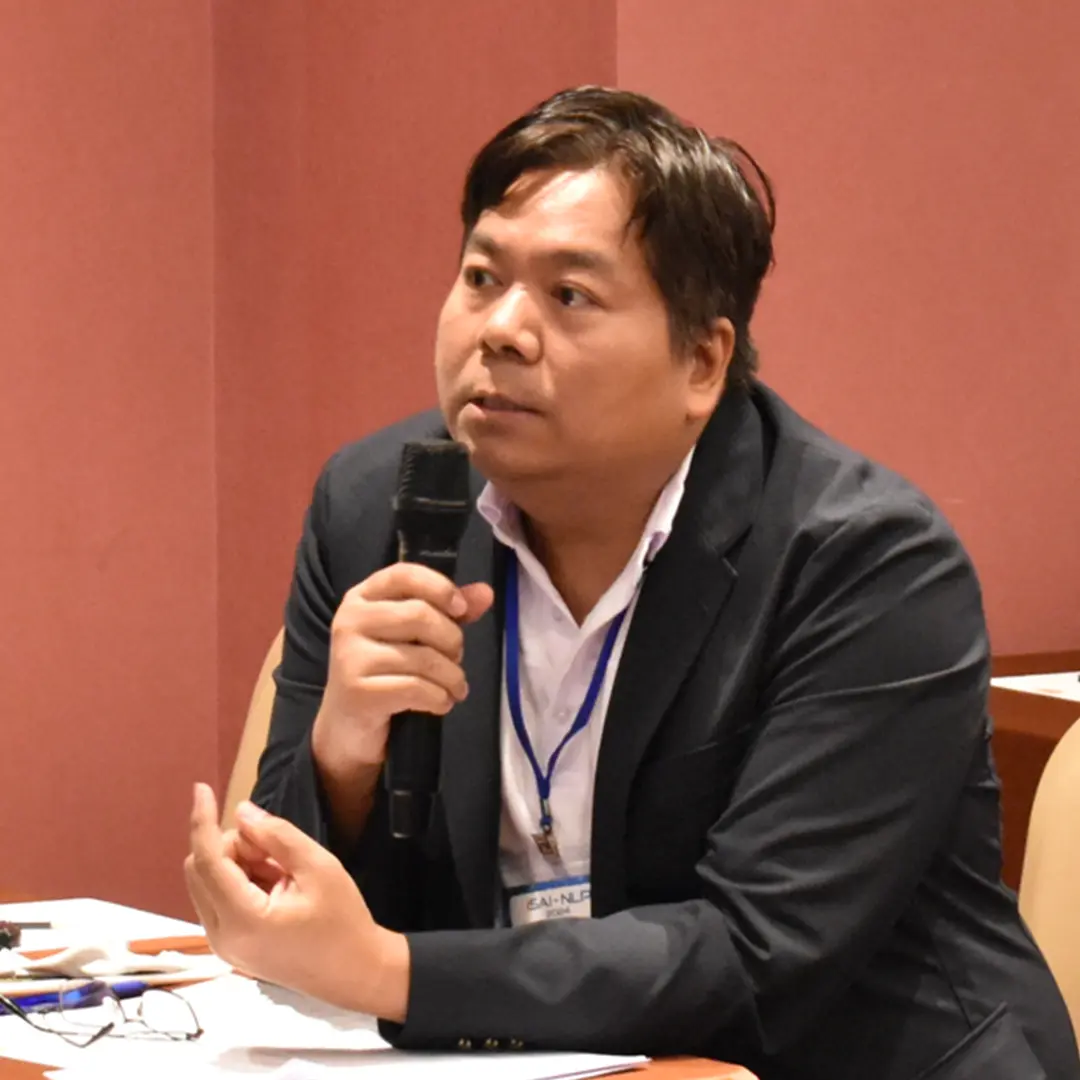
Ye Kyaw Thu, PhD
Visiting Professor, National Electronics and Computer Technology Center (NECTEC), Thailand
Hierarchical Reasoning & Tiny Recursive Models
- Abstract:
- Biography:
Reasoning ability is crucial for AI systems to handle complex, multi-step tasks in a robust and interpretable way. I will first review prompting-based strategies such as Chain-of-Thought, Tree-of-Thoughts, and Graph-of-Thoughts for inducing explicit reasoning structure in large language models. I then present the Hierarchical Reasoning Model (HRM), which employs multi-timescale computation to coordinate high-level planning and low-level execution within a unified architecture. Finally, I discuss Tiny Recursive Models (TRMs), which achieve compositional reasoning through repeated application of a small shared module, yielding strong performance with minimal parameters. Together, these methods point toward structured, modular approaches as a promising direction for advancing reasoning in AI.
Ye Kyaw Thu is a Visiting Professor at the National Electronics and Computer Technology Center (NECTEC), Thailand, where he has been since January 2019, and is the Founder of the Language Understanding Lab in Myanmar. He holds a Doctor of Science (2011) and a Master of Science (2006) from Waseda University, Japan, and a Bachelor of Science in physics from Dagon University, Myanmar (2000). He also holds diplomas in Computer Studies (UK). His research focuses on artificial intelligence (AI), natural language processing (NLP), and human-computer interaction (HCI). He supervises students at various institutions, including Assumption University (AU), Kasetsart University (KU), King Mongkut's Institute of Technology Ladkrabang (KMITL), Sirindhorn International Institute of Technology (SIIT), Thammasat University (TU), and the Japan Advanced Institute of Science and Technology (JAIST).
Homepage: https://sites.google.com/site/yekyawthunlp
GitHub: https://github.com/ye-kyaw-thu

Natthawut Kertkeidkachorn, PhD
Associate Professor in the Graduate School of Advanced Science and Technology,
Japan Advanced Institute of Science and Technology (JAIST), Japan
Knowledge-Aware AI through Knowledge Graphs
- Abstract:
- Biography:
In the age of generative AI and large language models, we have more data than ever, yet transforming this information into real knowledge remains a challenge. This talk explores the next frontier of AI: building knowledge-aware systems that combine the learning power of neural networks with the structured reasoning of Knowledge Graphs (KGs). By organizing information from diverse sources, enabling reasoning across interconnected data, and designing models that are interpretable, reliable, and transferable, Knowledge Graphs help us move from raw data to meaningful understanding. Through examples in natural language processing, financial intelligence, and educational technology, we will see how knowledge-centric design enhances interpretability, reliability, and cross-domain reasoning. The talk outlines a path from data to intelligent knowledge, showing how KGs can help us build AI that truly understands.
Natthawut Kertkeidkachorn is currently an Associate Professor in the Graduate School of Advanced Science and Technology at the Japan Advanced Institute of Science and Technology (JAIST). He received his B.Eng. and M.Eng. degrees in Computer Engineering from Chulalongkorn University, Bangkok, Thailand, in 2011 and 2013, respectively, and his Ph.D. in Informatics from the Graduate University for Advanced Studies (SOKENDAI), Japan, in 2017. From 2017 to 2021, he was a Researcher at the Artificial Intelligence Research Center, National Institute of Advanced Industrial Science and Technology (AIST), Japan, before moving to JAIST in 2021. His research interests include knowledge graphs, machine learning, and natural language processing.
Paper Submission Instructions
Importance Date
Paper length:
Full paper: 5-6 pages including figures, tables, and references.
Short paper: 3-4 pages including figures, tables, and references.
Deadline:
October 15, 2025 (GMT+7)
Notification of Acceptance:
October 29, 2025
Camera-Ready Submission:
November 5, 2025
Workshop Date:
November 12, 2025
Submission Format
Papers must be prepared under "IEEE Manuscript Templates for Conference Proceedings (A4)"
format as shown in the link below:
https://www.ieee.org/conferences/publishing/templates
Submission Methods
Please submit your papers to
Track "The 7th Workshop on Innovation Initiatives in NLP/AI/Education 2025"
in EasyChair
for iSAI-NLP 2025 as the link below:
 https://easychair.org/conferences?conf=isainlp2025
Review Process
For papers that are accepted for review, program committee (PC) members will be matched to submissions based on research expertise and interest. Authors will have a limited opportunity to respond to initial reviews. This author's feedback will then be taken into account in the final recommendations and reviews may be changed accordingly.
Journal Opportunities
A select set of rated papers may be nominated for fast track reviewing at the Journal of Intelligent Informatics and Smart Technology (JIIST).
Conference Registration and Attendance
At least one author is required to register for the conference to present the paper, and we encourage all authors to attend if possible.
Program Chairs
- Ye Kyaw Thu (NECTEC, Thailand)
- Nattapol Kritsuthikul (NECTEC, Thailand)
- Thepchai Supnithi (NECTEC, Thailand)
Schedule
revision 6 @ 2025-11-12
|
Time (UTC+07:00) |
Program |
|
November 12, 2025 |
|
|
08:45 – 09:00 |
Opening Ceremony |
|
09:00 – 09:30 |
Keynote 1 Ye Kyaw Thu, PhD Visiting Professor, National Electronics and Computer Technology Center (NECTEC), Thailand Title Hierarchical Reasoning & Tiny Recursive Models |
|
09:30 – 10:00 |
Keynote 2 Associate Professor Natthawut Kertkeidkachorn, PhD the Graduate School of Advanced Science and Technology Japan Advanced Institute of Science and Technology (JAIST), Japan Title Knowledge-Aware AI through Knowledge Graphs |
|
10:00 – 10:15 |
Coffee Break |
|
10:15 – 12:00 |
Oral Paper Presentation 4 Full papers (15 minutes), 3 Short papers (10 minutes) |
|
IINAE-2025-0002-F (iSAI-NLP-2025-0253) Title myFoodQA: A Multimodal Dataset for Evaluating Cultural and Visual Reasoning in Myanmar Gastronomy Authors Shin Thant Phyo, Pyae Linn, Lynn Myat Bhone, Thet Hmue Khin, Eaint Kay Khaing Kyaw and Ye Kyaw Thu |
|
|
IINAE-2025-0003-F (iSAI-NLP-2025-0255) Title Myanmar Text Readability Classification: Dataset Construction and Grade-Level Prediction Authors Khaing Hsu Wai, Hlaing Myat Nwe, Thura Aung, Kaung Khant Si Thu, Hsu Yee Mon, Seng Pan, Thiha Nyein, Yu Myat Moe, Ye Kyaw Thu, and Thazin Myint Oo |
|
|
IINAE-2025-0004-F (iSAI-NLP-2025-0250) Title Automated Grading Approach for Open-Ended STEM Answers using LLM Authors Piyanat Satcharattanachot and Sasiporn Usanavasin |
|
|
IINAE-2025-0005-F (iSAI-NLP-2025-0256) Title CHAI-Calibrated Hybrid Assessment for IELTS Speaking with Human-Referenced Validation Authors Phurinat Polasa, Settapun Laoaree, Thanapon Thanadunpremdet, Narabodee Rodjananant, and Nattapol Kritsuthikul |
|
|
IINAE-2025-0006-S (iSAI-NLP-2025-0254) Title RNN-Driven Inflow Forecasting for Dam Safety Monitoring Using Daily Local Meteorological Data Authors Manut Tanticharoen, Chirapot Vuthipraphan, Sakdipat Larlaeng, Sasiporn Usanavasin, Kanokvate Tungpimolrut, and Jessada Karnjana |
|
|
IINAE-2025-0007-S (iSAI-NLP-2025-0257) Title Automated Detection and Sentiment Analysis of Thai Siemsi (Fortune-Telling Papers) Using OCR and NLP Techniques Authors Chayudh Wannasinthop and Nattapol Kritsuthikul |
|
|
IINAE-2025-0008-S (iSAI-NLP-2025-0259) Title A Hybrid AI and Rule-Based System for Advanced Web Technology Stack Detection Authors Chaiyanat Kuptivej |
Venue
College of Computing, Prince of Songkla University, Phuket Campus
Phuket, Thailand
Sponsors